
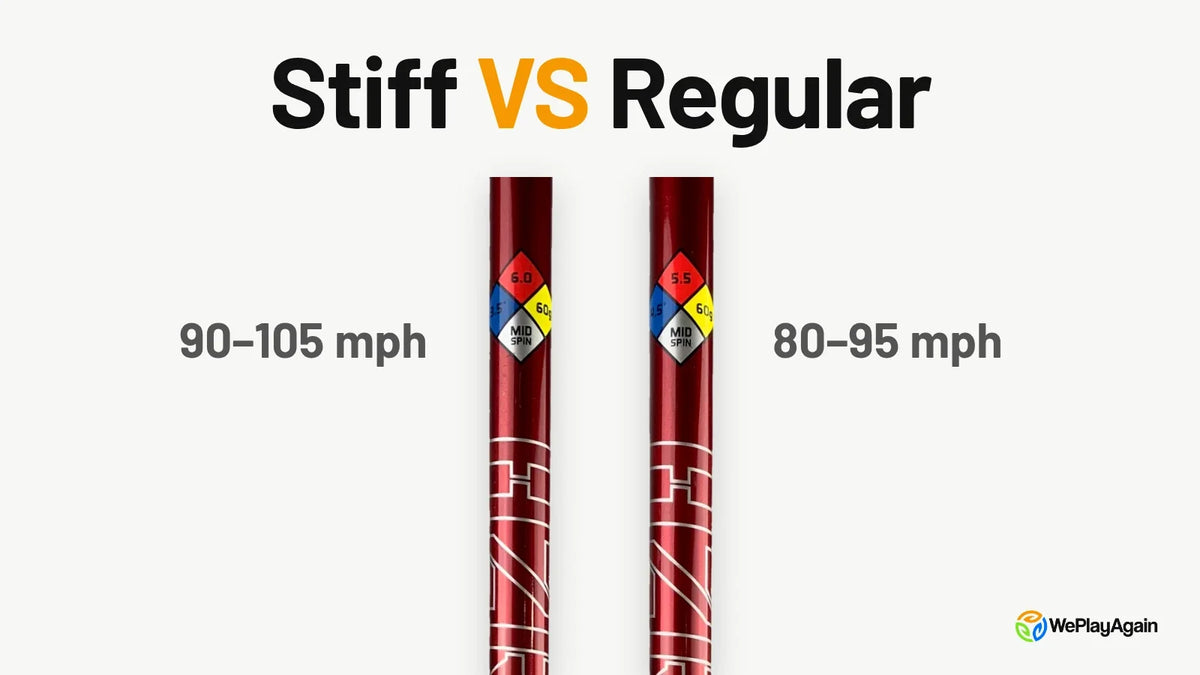
Short answer: In the stiff vs regular shaft choice, swing speed decides. Choose regular if your driver swing speed is about 80–95 mph, and stiff if it is about 90–105 mph. Those are UST Mamiya’s ranges for its dRVR shaft. The ranges overlap, and flex is not standardised between brands, so test both if you swing 90–95 mph.
Looking at a used driver and wondering if the R or the S on the shaft matters? It does, but the letter tells you less than you might think. Below we explain how the two flexes differ and how to match flex to your swing speed. We also cover senior flex. Finally, we show how to read the flex on used drivers with a regular flex shaft and other clubs.
What is the difference between a regular and a stiff shaft?
A stiff shaft bends less during the swing than a regular shaft. Flex is the word for how much a shaft bends. A faster swing bends the shaft more, so faster swingers usually need a stiffer shaft.
A stiff shaft is often a little heavier too. Take PING’s 2025 G440 MAX driver. Its ALTA CB Blue 50 shaft weighs 51 g in regular and 55 g in stiff. The PING Tour 2.0 Chrome 65 shaft weighs 56 g in regular and 61 g in stiff.
The letters are not a fixed standard. Golf media such as GolfWRX and GOLF.com point out that no industry rule says how stiff “stiff” must be. One brand’s regular shaft can play like another brand’s stiff shaft.
Which swing speed suits regular or stiff flex?
Regular flex suits a driver swing speed of about 80–95 mph, and stiff flex about 90–105 mph. Those are UST Mamiya’s own recommendations for its dRVR wood shaft. Swing speed is how fast the clubhead moves just before it hits the ball. UST also lists driver carry (the distance the ball flies in the air) for each flex.
| Flex (UST Mamiya dRVR) | Driver swing speed | Driver carry | Shaft weight | Launch (UST rating) |
|---|---|---|---|---|
| L (ladies) | Under 70 mph | Under 175 yds | 60 g | High |
| A (senior) | 70–85 mph | 175–215 yds | 63 g | High |
| R (regular) | 80–95 mph | 200–240 yds | 67 g | Mid-high |
| S (stiff) | 90–105 mph | 225–260 yds | 70 g | Mid-high |
Notice the overlaps. A swing speed of 80–85 mph fits both senior and regular. A swing speed of 90–95 mph fits both regular and stiff. In those zones, test both flexes and compare the results.

No launch monitor? Your carry distance gives a rough guide. On UST’s chart, regular matches 200–240 yards of driver carry and stiff matches 225–260 yards. Other makers use other ranges, so check the chart for the exact shaft. UST’s chart is on UST Mamiya’s dRVR product page.
How do you know if your shaft is too stiff or too soft?
Your ball flight gives the clues. These are patterns many golfers describe, not fixed rules.

- Too stiff: Many golfers find the ball flies lower than expected and misses to the right (for a right-hander). The club can also feel dead or hard to time.
- Too soft: Many golfers find the ball flies higher than expected and turns left (for a right-hander). The clubhead can feel hard to control.
A launch monitor at a range or a fitting gives you real numbers. Hit ten shots with each flex. Compare the average and the spread, not your one best shot.
Where does senior flex (A) fit in?
Senior flex sits between ladies and regular. It is usually marked A, and some sellers list it as senior or light. UST Mamiya recommends A flex for a driver swing speed of 70–85 mph.
On the dRVR, UST rates the A flex as high launch and the R flex as mid-high. Do your drives fly low with a regular shaft, at under 85 mph? Then test a senior shaft. You can compare drivers with a senior (A) flex shaft against regular models. PING offers a similar step on the G440 MAX. Its ALTA CB Blue 50 comes in Soft Regular, rated high launch.
Should your irons and woods have the same flex as your driver?
A matching flex is a sensible start, but it is not a rule. Many golfers play the same flex through the bag. Others play a softer flex in their fairway woods after a fitting, or a different flex in their irons.
Iron shafts often use other labels. True Temper’s steel Dynamic Gold shafts come in R300 (regular), S200, S300 and S400 (stiff) and X100 (extra stiff). So a used iron set may show a code instead of a single letter.
For fairway woods and hybrids, think about shaft weight as well as flex. We look at that in our comparison of a 7 wood and a 4 hybrid.
What should you check on the flex when you buy a used club?
Read the flex on the shaft itself, not just in the listing. Then check what that label means for that exact shaft model.
- Letters: L, A, R, S and X are the most common. UST, for example, uses L for ladies and A for senior.
- Words: PING’s 2025 G440 MAX lists Soft Regular, Regular, Stiff and X-Stiff across its stock shafts.
- Numbers: Project X shafts use numbers such as 5.5, 6.0 and 6.5. What each number means differs between Project X models.
- Other names: PING’s light ALTA Quick shaft comes in flexes called 35 and 45.
- Weight: The same letter can come in very different weights. On the G440 MAX, PING’s stiff stock shafts range from 55 g to 65 g.
- Replaced shafts: An earlier owner may have fitted a new shaft. Compare the shaft model with the maker’s stock options for that club.
Our advice
Start with your swing speed, then let your ball flight decide. These starting points use UST Mamiya’s dRVR ranges.
- Under 80 mph: start with senior flex, and compare it with regular.
- 80–90 mph: start with regular flex.
- 90–95 mph: test regular and stiff side by side.
- 95–105 mph: start with stiff flex, for example among our used stiff flex drivers.
- Over 105 mph: you are above UST’s stiff range for the dRVR, so test X-stiff too.
Pick the flex that gives you the most good shots, not your single longest drive. A shaft that only works on your best swing is the wrong shaft.
FAQ
Does a stiff shaft hit the ball further?
Not by itself. A stiffer shaft only helps if your speed suits it. Many slower swingers find a softer, higher-launching shaft gives them more carry.
Can a beginner use a stiff shaft?
Yes, if a launch monitor shows a swing speed in the stiff range. Many beginners find a regular or senior shaft easier to get in the air.
Is senior flex only for older golfers?
No. UST’s chart links A flex to swing speed, not to age. A younger golfer with a slower swing can play it. A fast-swinging older golfer may not need it.
What is the difference between ladies and senior flex?
Ladies (L) is the softest common flex. UST recommends L below 70 mph. On the dRVR, the L shaft is also the lightest at 60 g, against 63 g for A.
When does X-stiff make sense?
When your speed is above the stiff range for your shaft. PING’s Tour 2.0 Chrome 65 weighs 66 g in X-Stiff and is rated low-mid launch. The stiff version weighs 61 g and is rated mid launch.
Next steps
Get your driver swing speed measured at a range or a fitting, or use your average carry. Note the shaft model and flex that fit your numbers. If you only want to change the shaft, not the whole club, browse our used golf shafts.

Zostaw komentarz
Ta strona jest chroniona przez hCaptcha i obowiązują na niej Polityka prywatności i Warunki korzystania z usługi serwisu hCaptcha.