
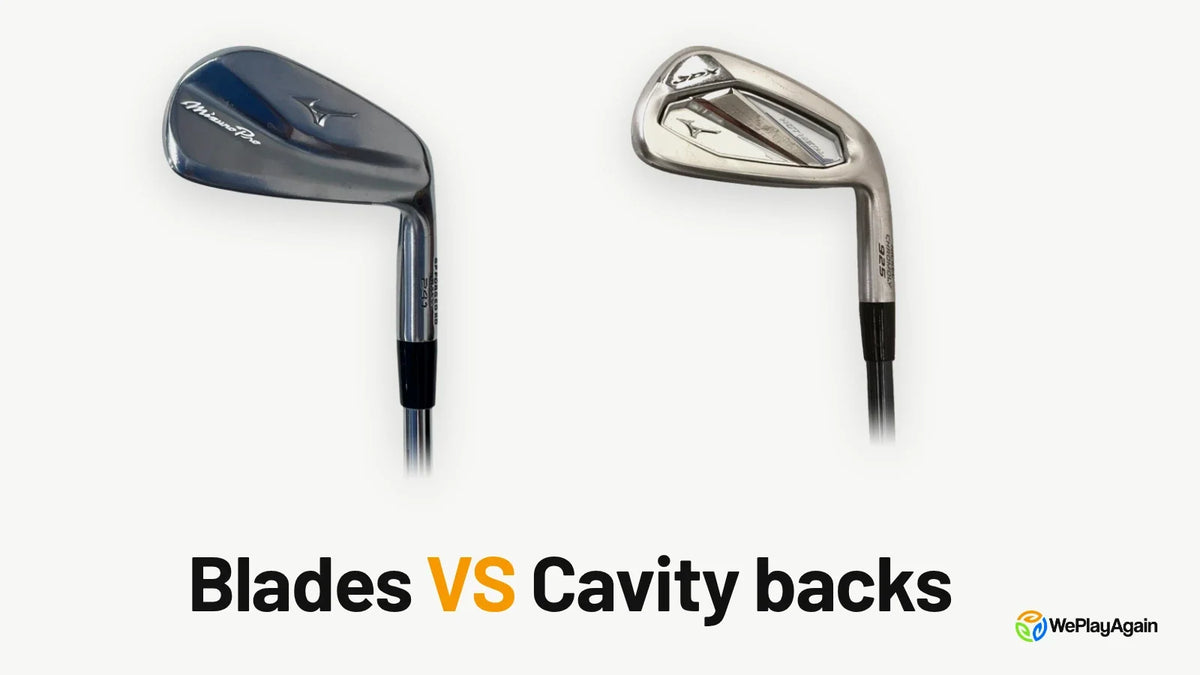
Short answer: Blades (muscle backs) put the mass right behind the centre of the face. They give clear feedback and precise control, but they punish off-centre strikes. Cavity backs move mass to the edges of the head, so mishits lose less speed and stay straighter. Most club golfers score better with a cavity back, while blades suit consistent ball-strikers who value feel.
Are you eyeing a set of forged blades but wondering if they will cost you shots? Or do you play cavity backs and wonder what you are missing? The blades vs cavity back question comes down to one thing. How often do you find the middle of the face? Below we compare the two designs and the options in between. We also explain what to check on used iron sets.
What is the difference between blades and cavity back irons?
The difference is where the weight sits. A blade, also called a muscle back, has a solid back. The mass sits behind the sweet spot (the centre of the face). A cavity back has a hollowed-out back, and that mass is moved out to the heel, toe and sole.
Mizuno describes its Mizuno Pro S-1 (2025) as a pure muscle back. It is forged in one piece from mild carbon steel. The Mizuno JPX925 Hot Metal (2024) sits at the other end. Mizuno calls it a forgiving speed cavity for mid to high handicappers. It has a thin face and tungsten low in the 4- to 7-irons.
The shape around the face differs too. Cavity backs usually have a thicker topline, a wider sole and more offset. The topline is the top edge you see at address. Offset is how far the face sits behind the hosel (the neck of the club). The Mizuno Pro S-1 7-iron has 0.087 inches (about 2.2 mm) of offset. The Mizuno JPX925 Hot Metal 7-iron has 0.189 inches (about 4.8 mm).
Are cavity back irons more forgiving than blades?
Yes. Perimeter weighting makes the head resist twisting when you miss the centre. Titleist explains this in its own guide to cavity back irons. In practice, a toe or heel strike keeps more ball speed and holds its line better.
A blade gives less help. Many golfers find that a toe strike with a blade comes up short and drifts offline. They often notice the gap most in the long irons, where speed and launch are harder to find.
Distance is not only about forgiveness, though. Distance-focused cavity backs can have much stronger lofts. The Mizuno Pro S-1 7-iron has 34° of loft, while the Mizuno JPX925 Hot Metal 7-iron has 28°. The same number on the sole is not the same club, so compare lofts when you test two sets.
Do blades really give more feel and control?
Blades give clearer feedback, and that is why many better players like them. With the mass behind the centre, you feel at once if you hit it on the toe. Mizuno says the centre mass on its muscle backs is there to enhance feedback.
Control here means shaping the ball left or right and changing the height of the shot. Makers link a compact head and low offset to workability (how easily you can shape shots). A cavity back can still curve the ball. But the bigger head and extra offset favour a straighter, higher flight.
Where do players' cavity backs and hollow-body irons fit?
They sit in the middle, for golfers who strike it well but not every time. A players' cavity has a compact, blade-like shape with a shallow cavity behind the face. A hollow-body iron looks like a blade from behind but is hollow inside, sometimes with tungsten weighting.

Mizuno's 2024 Pro range shows all three in one family. The Mizuno Pro 241 is the muscle back and the Mizuno Pro 243 the tour cavity. The Mizuno Pro 245 is the hollow body. Mizuno says the Mizuno Pro 245 has a traditional blade appearance. Inside, the 2- to 7-irons carry tungsten to help launch.
| Blade (muscle back) | Players' cavity or hollow body | Game-improvement cavity | |
|---|---|---|---|
| Weight | Behind the centre | Shallow cavity or hollow head | Out to the perimeter and low |
| Head size | Compact | Compact to medium | Larger |
| Topline and sole | Thin topline, narrow sole | In between | Thicker topline, wider sole |
| Offset | Low | Low to medium | More |
| Help on mishits | Little | Some | Most |
| Feedback | Very clear | Clear | Softer, less obvious |
| Example | Mizuno Pro S-1 (2025) | Mizuno Pro 243 or 245 (2024) | Mizuno JPX925 Hot Metal (2024) |
| Suits | Consistent ball-strikers | Good strikers who want some help | Most club golfers |
Can you mix blades and cavity backs in one set?
Yes, and for many golfers it is the smartest set-up. A combo set uses cavity backs or hollow-body irons at the long end and blades in the short irons. You get help where mishits hurt most and precision where you aim at flags.
Some makers design their ranges for this. Mizuno says its Mizuno Pro 241, 243 and 245 are each distinct but can be blended when required. Mizuno also makes the hollow Mizuno Pro Fli-Hi (2024) as a tour long iron.
If the long irons are the real problem, a hybrid or a high-lofted wood can take their place. Our 7 wood vs 4 hybrid guide helps you choose between those two.
What should you check on used blades or cavity backs?
Check the face, the grooves, the loft and lie, and the shaft. Many forged blades are made of mild carbon steel. Look closely at the leading edge and sole for dents. Light bag chatter (small marks from clubs knocking together) is only cosmetic.
Look at the grooves (the lines in the face) on the 8-iron down to the wedges. Some golfers notice less spin from short irons with worn grooves. A used set may have been bent to suit a previous owner. Have loft and lie checked if the ball flight seems off.

Finally, match the shaft to your swing. A blade with a heavy, stiff shaft is hard work for a slower swing. Looking through pre-owned Mizuno clubs is a quick way to compare blade, cavity and hollow-body shapes side by side.
Our advice
Choose by how consistent your strike is, not by your handicap alone.
Mostly centred strikes and you like to shape shots: try blades. A combo set with blades from the 8-iron down is another option.
Good striker who still misses on the toe or heel: try a players' cavity or hollow-body iron. You get the look with some help.
Inconsistent strike or a slower swing: a game-improvement cavity back will save shots. Mizuno itself aims the JPX925 Hot Metal at mid to high handicappers.
If you can, hit both types on a launch monitor. Compare carry and dispersion (how widely the shots land), not just your best shot.
FAQ
Are muscle backs and blades the same thing?
Yes. Golfers use both words for the same design. It has a solid back with the mass behind the centre. Titleist's MB irons, for example, are its muscle backs.
Are all forged irons blades?
No. Forging describes how the head is made, not its shape. The Mizuno Pro 243 (2024) is forged but has a cavity back.
Do tour players still use blades?
Some do. In 2023 Mizuno said its muscle back had become its most played model on tour.
Can a beginner learn with blades?
You can, but it makes the game harder than it needs to be. Beginners miss the centre often, and blades give little help on those shots. Start with a cavity back and look at blades again when your strike is more consistent.
Will blades make me a better ball-striker?
Not by themselves. Blades show your misses more clearly, which some golfers find useful in practice. The swing still has to improve, and a cavity back will usually score better while it does.
Next steps
Know which type you lean towards? Browse used Titleist iron sets and compare head shapes and lofts before you choose. Do your current irons no longer suit your game? You can sell your old irons to us and put the money towards the right set.

Efterlad en kommentar
Denne side er beskyttet af hCaptcha, og hCaptchas Politik om beskyttelse af persondata og Servicevilkår er gældende.