
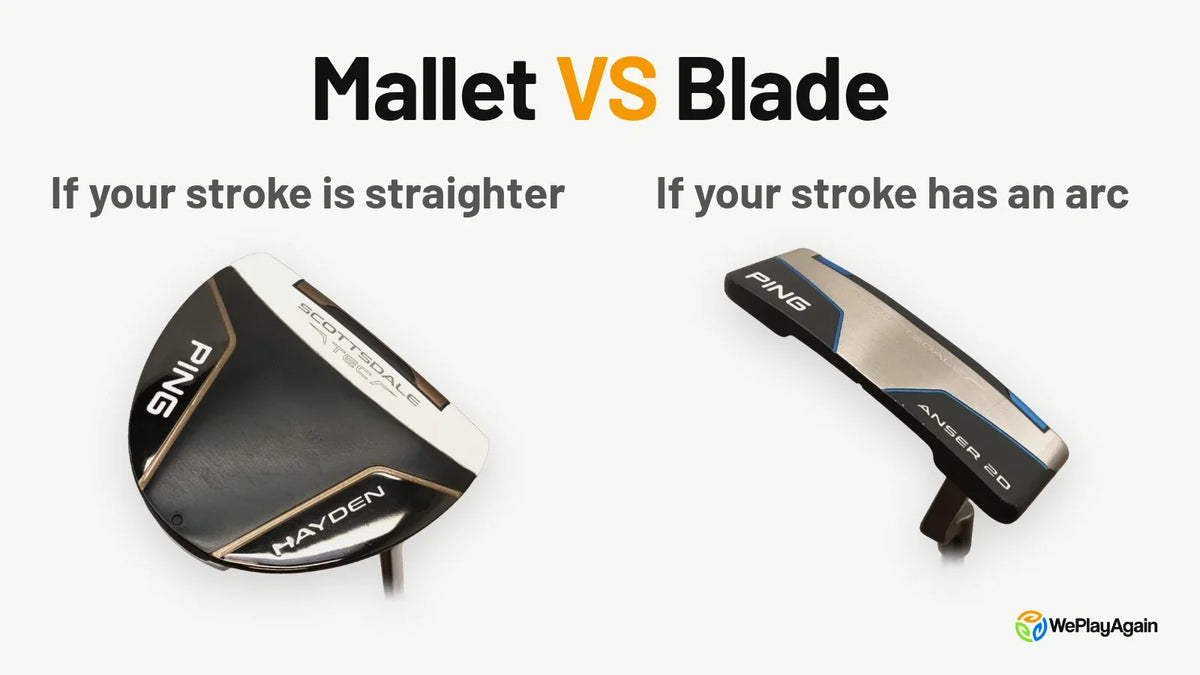
Short answer: In the mallet putter vs blade choice, your stroke should decide. Choose a blade if your stroke has an arc and you like feedback from the face. Choose a mallet if your stroke is straighter or you want more stability on off-centre hits.
Do you miss short putts and wonder if your putter is part of the problem? Many golfers switch between a blade and a mallet without knowing what really changes. Below we compare head shape, toe hang and forgiveness. We also cover what to check before you buy one of our used putters.
What is the difference between a blade and a mallet putter?
A blade putter has a narrow head with most of its weight close to the face. A mallet putter has a larger head that reaches further back from the face. A mid-mallet sits in between.
The shape changes where the weight can sit. In a mallet, makers move weight out to the edges and further back. That raises the MOI (moment of inertia), which is how much the head resists twisting. PING’s Scottsdale Anser (2025) is a blade with a 345 g head. PING’s Scottsdale TEC Hayden (2026) is a mallet with a 360 g head.
Blade or mallet putter: which suits your stroke?
Match the putter’s balance to your stroke, not just its shape. A putter with toe hang suits a stroke that moves on an arc. A face-balanced putter suits a straighter stroke.
Toe hang means the toe points down when you balance the shaft on your finger. On a face-balanced putter, the face points up at the sky instead. You can do this test in any shop or at home.
Many blades have toe hang and many mallets are face-balanced, but not all. PING labels its putters by stroke type: straight, slight arc or strong arc. Both its blades and its mallets cover more than one stroke type. PING’s Scottsdale TEC Ketsch 4 specifications show a mallet built with extra toe hang for a strong arc.
| PING putter | Type | Head weight | Stroke type |
|---|---|---|---|
| Scottsdale Anser (2025) | Blade | 345 g | Slight arc |
| Scottsdale Anser 2D (2025) | Blade | 360 g | Slight arc |
| Scottsdale Anser 4 (2025) | Blade | 345 g | Strong arc |
| Scottsdale TEC Hayden (2026) | Mallet | 360 g | Straight |
| Scottsdale TEC Ally Blue H (2026) | Mallet | 370 g | Slight arc |
| Scottsdale TEC Ketsch 4 (2026) | Mallet | 365 g | Strong arc |
Not sure what your stroke looks like? PING has said that most golfers have some arc in their stroke. PING’s online WebFit tool and most putter fitters can measure your stroke type for you.
Is a mallet putter more forgiving?
Usually, yes. A head with a higher MOI twists less when you hit the ball off the centre of the face. TaylorMade explains that this helps the ball hold its line and its distance on mis-hits.

Blades have closed some of the gap. PING says its Scottsdale Anser 2D (2025) is a deeper blade that rivals a mid-mallet for forgiveness. Its head weighs 360 g, against 345 g for the standard Scottsdale Anser.
Some golfers find a big mallet harder to judge on long putts. Others feel calmer over short putts with one. That is experience, not a rule, so try both types on a practice green.
Which helps more with alignment and distance control?
A mallet usually gives more help with alignment. The longer head leaves room for lines and shapes that point at the target. PING’s Scottsdale TEC Hayden has a long alignment line that draws your eye forward. The Scottsdale Anser blade has a single alignment line.

Distance control depends more on contact and feel than on head shape. Many golfers find a blade gives clearer feedback on where they struck the ball. Others prefer the softer feel of a putter with a face insert.
What should you check when you buy a used putter?
Check the face, the shaft and the balance first. A putter has few parts, but small faults change how it sits and rolls.
- Face and insert: look for dents, deep marks or an insert that is coming loose.
- Shaft: look down it to check that it is straight. Check the hosel (the neck that joins head and shaft) too.
- Toe hang: do the balance test, so you know which stroke the putter suits.
- Loft and lie: a previous owner may have had them adjusted. A fitter can measure both.
- Length: take your address position and check that your eyes feel comfortable over the ball.
- Grip: a shiny, hard or twisted grip needs replacing.
Our advice
The blade vs mallet putter choice comes down to your stroke first and the look second.
- Your putter moves on an arc and you like feedback: start with a blade that has toe hang.
- Your stroke is straight back and through: start with a face-balanced mallet.
- You often strike putts off the toe or heel: try a mallet or a deeper blade.
- You are unsure of your stroke: have it measured before you choose.
Then putt with both types on a practice green. Count how many short putts you hole and how close your long putts finish. If the blade wins, browse our used blade putters and check the toe hang of each one.
FAQ
Is a mid-mallet a good compromise?
Yes, if you want more stability than a blade but a smaller head than a full mallet. Check the toe hang as you would on any putter. You can compare shapes among our mid-mallet putters.
Can beginners use a blade putter?
Yes. A putter that fits your stroke and your height matters more than the head shape. Many beginners still find a mallet easier to aim.
Does putter length matter more than head shape?
Length matters just as much. A putter that is too long or too short changes your posture. It also moves your eyes over the ball. Check the length before you judge the head.
What does a face insert do?
An insert is a softer material set into the face. PING says the PEBAX insert in its Scottsdale TEC putters gives a softer feel and consistent distance control. Golfers who like a firmer click often prefer a milled metal face.
What is a counterbalanced putter?
A counterbalanced putter moves the balance point up towards your hands, often with a longer shaft and grip. PING’s Scottsdale TEC Ally Blue Onset CB has a 37.75-inch shaft and a 17-inch grip. Some golfers find it quietens their hands in the stroke.
Next steps
Do the balance test on your current putter and compare it with your stroke. If they do not match, that is the first thing to change. Then compare our used mallet putters with the blades. When you have found your new putter, you can sell your old putter to us.

Efterlad en kommentar
Denne side er beskyttet af hCaptcha, og hCaptchas Politik om beskyttelse af persondata og Servicevilkår er gældende.